
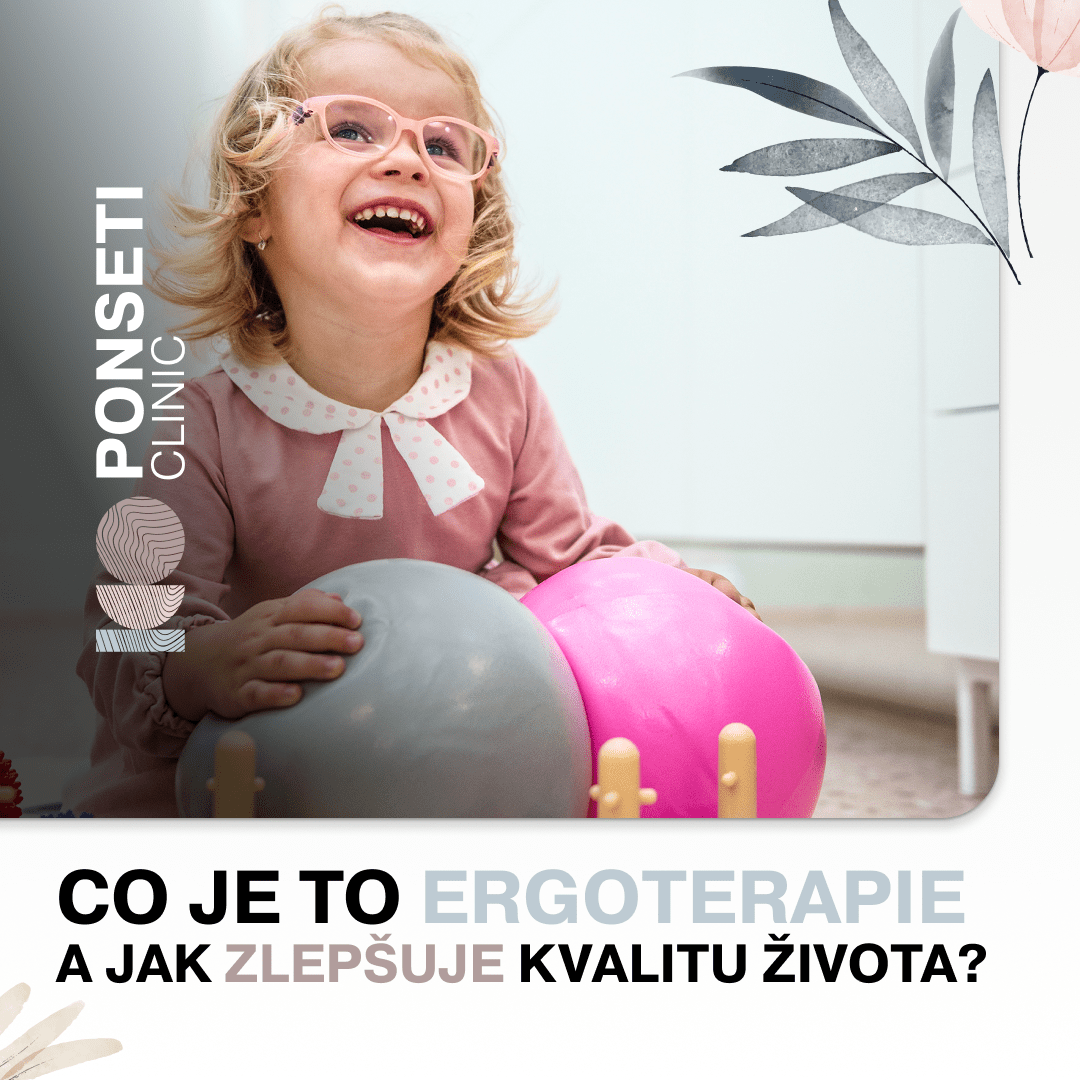
A playful, professional approach to developing children’s skills
21. November 2024
Occupational therapy for children is often associated with play and fun activities, thanks to which the child perceives therapy as pleasant entertainment, not as treatment. This can sometimes raise questions for parents, such as "Is my child playing, or is there a deeper therapeutic meaning?" At the Ponseti clinic, each activity in occupational therapy has its own clear goal, which aims to develop key skills. These skills are necessary for a child's daily independence, school success and healthy social functioning.
How does occupational therapy work?
Children's occupational therapy is based on an approach that engages children and at the same time develops their abilities. If we show it in concrete activities, the child during therapy, for example, draws with his fingers in the foam on the mirror. While at first glance it looks like an ordinary game, in fact such an activity has an important therapeutic meaning: the child practices sensory sensitivity, improves fine motor skills needed for example for writing and learns to properly regulate pressure. Thanks to these skills, he can better manage tasks at school, but also in everyday activities.
In addition to a playful approach, the therapeutic tasks are always adapted to the specific needs of the child, for example according to his diagnosis or specific difficulties with which he comes to occupational therapy.
Most common diagnoses in pediatric occupational therapy
Occupational therapy focuses on supporting children with various health and developmental difficulties. At the Ponseti Clinic, we often work with children with the following diagnoses:
- Autism Spectrum Disorders (ASD): Support focused on the development of sensory perception and social interaction.
- Attention deficit hyperactivity disorder (ADHD): Concentration and impulse control training.
- Cerebral Palsy (CP): Development of motor skills, coordination and self-care.
- Fine and gross motor disorders: Exercises to strengthen muscles, improve grip and coordination of movements.
- Sensory Integration Difficulties: Therapy helps children process sensory stimuli in an appropriate way.
These and other diagnoses can cause children a variety of difficulties in everyday life, from writing and drawing to managing everyday tasks such as dressing or preparing meals.
Supporting everyday life skills
The main goal of occupational therapy is to support the skills a child needs for normal activities of daily living (ADL). This includes the ability to dress, take care of hygiene, handle objects or eat with cutlery. At each meeting, the occupational therapist suggests targeted activities that strengthen certain skills. For example, a child who has difficulty handling cutlery will be offered tasks aimed at strengthening hands and improving coordination of movements. These activities lead to an increase in self-sufficiency and self-confidence of the child.
Development of sensory skills
Many children have difficulties in the area of sensory perception – they may be hypersensitive to certain touches, textures or sounds, for example, or on the contrary, they need more stimulation to register the stimulus. In occupational therapy, we work on the development of sensory abilities so that the child can perceive stimuli from his environment, but also from himself in an appropriate and non-stressful way. Various activities are used for this, for example, touching different materials, working on swings, or activities on unstable surfaces. Such activities help the child to better prepare for situations he will experience at home, in kindergarten or school, and to respond to various sensory stimuli with greater confidence.
Expert Recommendation
In children's occupational therapy, playfulness is essential - children learn best when they feel good. Ergotherapeutic activities at the Ponseti clinic are therefore prepared in such a way that they interest and motivate the child and at the same time teach him the necessary skills. When a child is having fun, it develops more naturally, which has a long-term positive effect on its growth and development.
Specialists also recommend combining ergonomic seating with enough movement during the day. An active lifestyle, including regular exercise, helps keep the muscles around the spine strong and flexible, which is key to healthy posture. To improve posture, the use of some rehabilitation and ergonomic aids, such as an overball or a reading stand, can be recommended. In the home environment, it is also possible to provide the possibility of using an alternative seat, again with the help of a balance ball or kneeler.
We are Ponseti Clinic. We give strength to rise.